
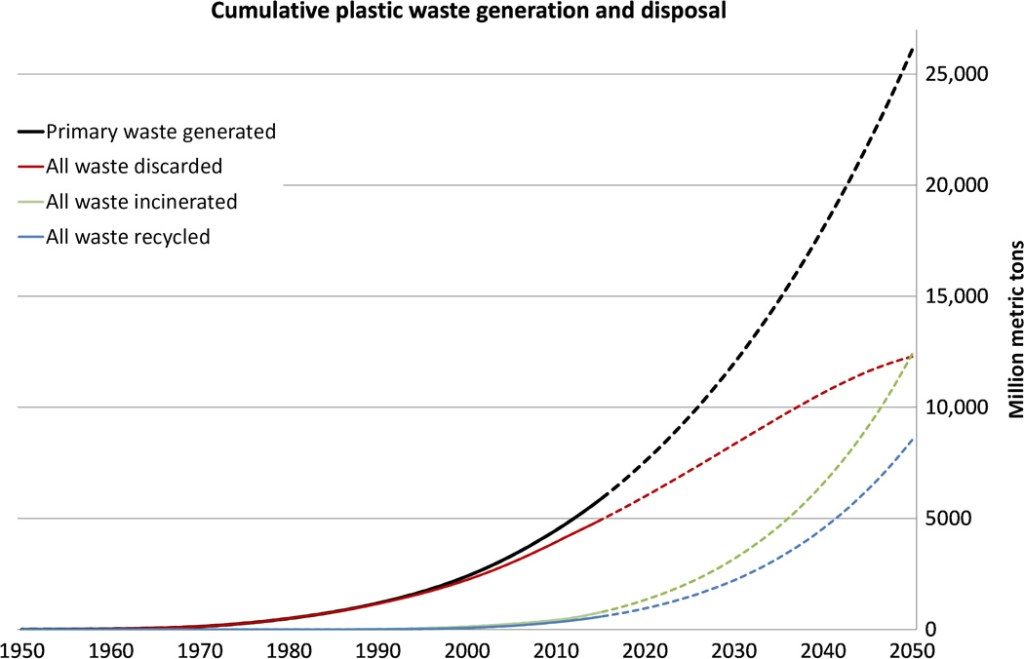
A research article published in 2017 by Geyer, Jambeck, and Law, in the Science Advances magazine, estimates that since 1950, a total of 8300 million metric tons (Mt) of virgin plastics have been produced. As of 2015, they estimate plastic waste to have reached 6300 Mt. globally, with only about 9% being recycled, while 12% was incinerated, and 79% ended up in landfills or left uncontrolled in the natural environment or in open dumps. If these production and waste trends persist, they estimate that about 12,000 Mt of plastic waste will be generated by 2050.
The group of researcher recognizes that “the same properties that make plastics so versatile in innumerable applications—durability and resistance to degradation—make these materials difficult or impossible for nature to assimilate.”
Some key data and facts stand out from multiple studies:
- Global plastic production went from 35 million tons in 1970, to 213 million tons in 2000 to 381 million in 2015, and is increasing exponentially.
- Solid waste increases with income. Higher income communities generate more plastic waste than lower income communities.
- 42% of non fiber plastics (all but PP&A – polyester, polyamide, and acrylic) have been produced for packaging.
- 19% of non fiber plastics have been made for the building and construction sector.
- Out of 5800Mt of the plastic waste generated in 2015, 700Mt was PP&A.
- 30% of all plastics ever produced are estimated to still be in use.
- Textiles made of fiber plastics are rarely recycled.
- 18% of non fiber plastics were recycled globally in 2014.
- Europe and China recycle the most (30% and 25% of all plastic), while the United States inly recycles 9% of all plastic wasted.
- To have as low gas emission as a standard single-used plastic bag, an organic cotton reusable bag would need to be used 20,000 times.
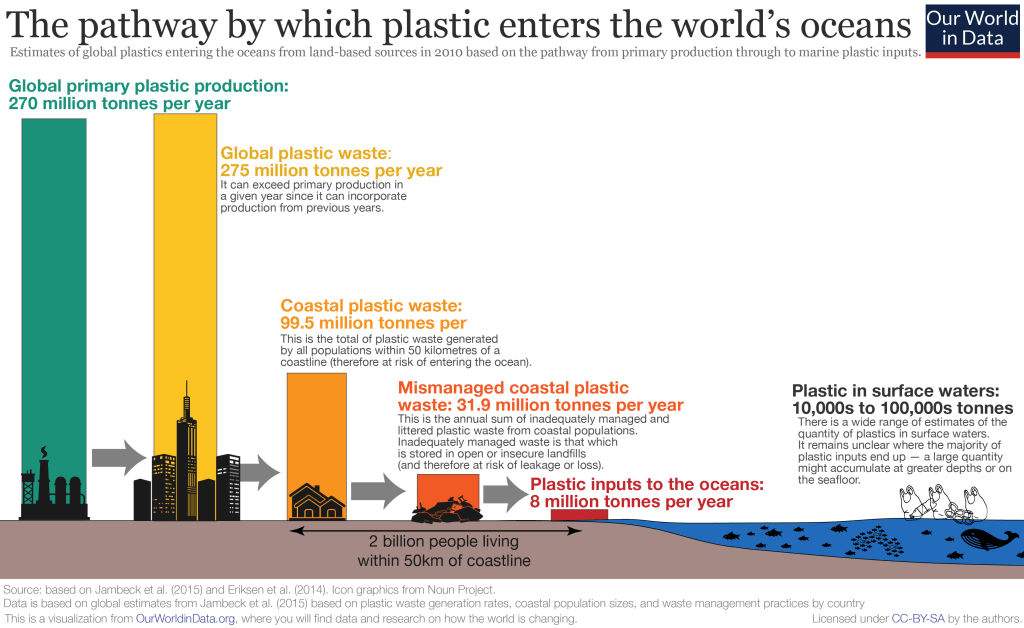
- It is estimated that 20% of the plastic waste in the ocean come from marine sources, such as fishing nets, ropes and lines.
- There will be as much plastic as fish in the ocean by weight by 2050.
- Plastic pollution in the ocean is estimated to cost $13 billion each year in economic damage to marine ecosystem, of course not counting the already irreparable damage done to marine wildlife.
- Out of all the plastic production, PP&A is the one that make up for the largest emission of green house gas.

 mygreenhome.blog